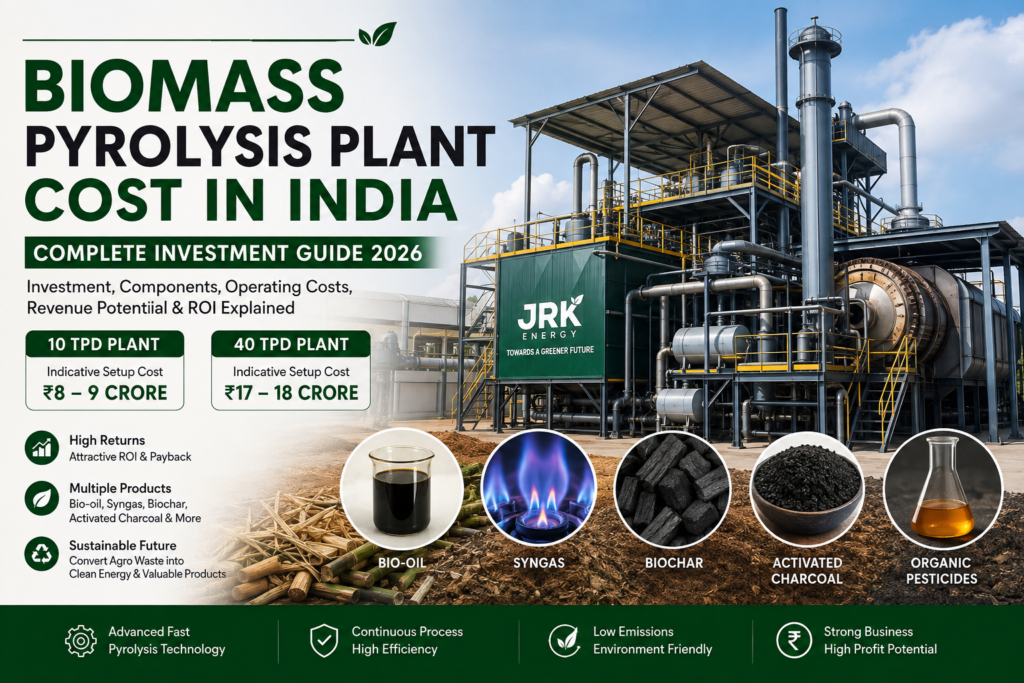
India generates enormous quantities of agricultural and biomass waste every year. Rice husk, bamboo waste, sugarcane bagasse, cotton stalks, sawdust and other dry agro residues are often treated as waste, but modern pyrolysis technology can convert these materials into valuable products such as bio-oil, syngas, biochar or activated charcoal and other useful outputs.
This has made biomass pyrolysis plants increasingly interesting for industrial businesses, entrepreneurs, investors, FPOs, waste-management companies and organizations looking for scalable waste-to-energy solutions.
But the first question most investors ask is simple:
How much does a biomass pyrolysis plant cost in India?
The answer depends on several factors, including plant capacity, technology, feedstock, land, civil work, material handling, automation, utilities, storage, pollution-control requirements and the products you plan to manufacture.
For a commercial project, JRKENERGY currently indicates an approximate setup cost of ₹8–9 crore for a 10 TPD plant and ₹17–18 crore for a 40 TPD plant. These are indicative project figures, not universal market prices, because the final investment depends on the specific plant configuration and site requirements.
In this guide, we explain the major factors that determine biomass pyrolysis plant cost in India, compare 10 TPD and 40 TPD capacities, discuss potential revenue streams and explain what investors should evaluate before setting up a plant.
What Is a Biomass Pyrolysis Plant?
A biomass pyrolysis plant is an industrial system that thermally decomposes biomass in the absence of oxygen or with very limited oxygen.
Unlike combustion, where biomass is burned in the presence of oxygen, pyrolysis breaks down organic material through controlled heating.
Depending on the technology and operating conditions, biomass pyrolysis can produce different combinations of:
- Bio-oil
- Syngas
- Biochar or charcoal
- Organic compounds
- Other value-added products
The exact output depends on the feedstock, reactor design, temperature, residence time and overall process configuration.
JRKENERGY uses a continuous Fast Pyrolysis system designed to process dry agro waste and convert it into multiple commercial products. Its published process includes feedstock preparation, drying, rapid heating in a pyrolysis reactor, vapor condensation, char collection and utilization of non-condensable gases within the system.
How Much Does a Biomass Pyrolysis Plant Cost in India?
There is no single fixed price for a biomass pyrolysis plant.
For commercial projects, the investment can vary substantially depending on capacity and scope.
Based on JRKENERGY’s currently published project models:
| Plant Capacity | Indicative Setup Cost | Typical Application |
|---|---|---|
| 10 TPD | ₹8–9 crore | Smaller commercial projects, FPOs, cooperatives and decentralized biomass processing |
| 40 TPD | ₹17–18 crore | Larger industrial and commercial operations |
These figures should be treated as indicative project-level estimates, not a standard market price. The actual cost should be established through a detailed feasibility study, plant configuration, site assessment and DPR.
JRKENERGY’s network model also publishes indicative annual revenue figures of approximately ₹9–12 crore for a 10 TPD plant and ₹35–40 crore for a 40 TPD plant, with stated payback estimates of approximately 2–2.5 years and around 2 years respectively. Actual financial performance will depend on feedstock cost, operating hours, product yields, selling prices, logistics, financing and plant utilization.
What Determines the Cost of a Biomass Pyrolysis Plant?
Simply looking at the price of the reactor is not enough.
A complete biomass pyrolysis project consists of several systems working together.
1. Plant Capacity
Capacity is one of the biggest factors affecting investment.
A 10 TPD plant processes approximately 10 tonnes of suitable biomass feedstock per day, while a 40 TPD plant is designed around four times that daily processing capacity.
Larger plants generally require:
- Larger feedstock handling systems
- Higher-capacity shredders
- Larger drying systems
- Bigger reactors
- Larger condensers
- Greater storage capacity
- Larger product-handling systems
- More extensive utilities and infrastructure
However, larger capacity can also improve economies of scale when the plant operates consistently and has reliable access to biomass and buyers.
10 TPD vs 40 TPD Biomass Pyrolysis Plant
For investors deciding between different plant sizes, capacity selection should not be based purely on available capital.
The most important question is:
Can you reliably source enough suitable biomass and sell the resulting products?
A 40 TPD plant can be attractive when there is a strong local feedstock supply chain and established product demand.
A 10 TPD plant may be more appropriate for decentralized operations where biomass is available locally but transporting large quantities over long distances would become expensive.
10 TPD Plant
A 10 TPD system can be considered by:
- FPOs
- Farmer cooperatives
- Local entrepreneurs
- Biomass aggregators
- Decentralized waste-management projects
- Smaller industrial operators
JRKENERGY currently publishes an indicative setup cost of ₹8–9 crore for its 10 TPD model.
40 TPD Plant
A 40 TPD plant is more suitable for:
- Industrial-scale operations
- Large biomass aggregators
- Waste-management companies
- Investors with established supply chains
- Larger decentralized energy projects
- Organizations targeting multiple revenue streams
JRKENERGY currently publishes an indicative setup cost of ₹17–18 crore for its 40 TPD model.
The important point is that plant capacity should be selected based on feedstock availability, logistics and product-market demand—not simply on production ambition.
Major Components of a Biomass Pyrolysis Plant
A commercial pyrolysis project is much more than a reactor.
Depending on the technology and project configuration, the major systems can include:
1. Biomass Receiving and Storage
The plant needs an organized system for receiving and storing agricultural waste.
Potential feedstocks include:
- Bamboo waste
- Rice husk
- Sugarcane bagasse
- Cotton stalks
- Sawdust
- Other suitable dry agricultural residues
JRKENERGY’s process specifically describes bamboo, sugarcane bagasse, rice husk and cotton stalks among potential agro-waste inputs.
2. Shredding and Size Reduction
Biomass generally needs to be processed to a suitable particle size before entering the pyrolysis system.
Consistent feedstock size helps improve heat transfer and process control.
JRKENERGY states that its process includes shredding and pulverizing the biomass before pyrolysis.
3. Drying System
Moisture content directly affects the efficiency of thermal processing.
Excess moisture can increase energy requirements because additional energy is required to remove water before effective pyrolysis can take place.
JRKENERGY’s published process targets biomass moisture below 10% before processing.
4. Pyrolysis Reactor
The reactor is the core component of the plant.
In JRKENERGY’s Fast Pyrolysis process, prepared biomass is fed into a continuous horizontal auger reactor and rapidly heated in an oxygen-limited environment.
The reactor design, heating system, residence time, throughput and temperature control can have a significant impact on plant performance.
5. Condensation System
During pyrolysis, vapors are generated.
These vapors can be rapidly cooled through condensation systems to recover liquid products such as bio-oil.
The quality and quantity of recovered liquid products depend heavily on process conditions and feedstock characteristics.
6. Char Collection System
The solid fraction generated during pyrolysis needs to be separated, cooled and collected.
Depending on the process and product specification, this material may have applications as biochar, charcoal or as a feedstock for further processing.
JRKENERGY describes activated charcoal as one of its commercial output streams.
7. Syngas Handling
Pyrolysis also generates non-condensable gases.
Instead of treating these gases simply as waste, an integrated system can potentially utilize them for process heat.
JRKENERGY states that its syngas is routed to burners to support plant heating, reducing dependence on external energy.
What Are the Main Operating Costs?
The capital investment is only one side of the calculation.
Investors must also understand ongoing operating costs.
The major operating expenses can include:
Biomass Feedstock
Feedstock is often one of the most important variables.
The cost depends on:
- Type of biomass
- Local availability
- Seasonality
- Collection costs
- Farmer payments
- Transportation
- Moisture content
- Pre-processing requirements
A plant with cheap machinery but expensive or unreliable feedstock can still be financially unattractive.
Labour
A commercial plant requires operators, maintenance personnel, supervisors, feedstock-handling staff and management.
Automation can reduce manual intervention but does not eliminate the need for trained personnel.
Electricity and Energy
Power may be required for:
- Shredders
- Conveyors
- Pumps
- Fans
- Dryers
- Control systems
- Material handling
- Auxiliary equipment
An integrated system that recovers process gases can reduce external energy requirements.
Maintenance
Regular maintenance is essential for:
- Reactors
- Motors
- Conveyors
- Pumps
- Condensers
- Heating systems
- Control systems
Maintenance costs should be included in the financial model rather than ignored during the initial investment calculation.
Logistics
Biomass is bulky and relatively low in energy density compared with finished fuels.
Therefore, transportation distance can significantly affect project economics.
This is one reason decentralized biomass processing can make sense when suitable feedstock is available close to the plant.
How Does a Biomass Pyrolysis Plant Make Money?
The biggest advantage of a multi-product pyrolysis system is that the business does not necessarily depend on a single product.
A biomass pyrolysis plant can potentially generate revenue from multiple streams.
1. Bio-Oil
Bio-oil is a liquid product obtained by condensing pyrolysis vapors.
Depending on its properties and further processing, it can have applications as an industrial fuel or chemical feedstock.
JRKENERGY identifies bio-oil and LDO among its industrial fuel-related output streams.
2. LDO
LDO can provide another commercial product stream depending on the plant’s process configuration and product specifications.
Industrial fuel applications can create potential demand from sectors that currently rely on conventional fuels.
However, product quality, applicable regulations and buyer requirements must be evaluated before projecting sales.
3. Activated Charcoal
The solid fraction can potentially be processed and marketed as charcoal or activated charcoal for different applications.
JRKENERGY states that its activated charcoal has applications across multiple industries, including agriculture, cosmetics, pharmaceuticals and water treatment.
The actual selling price depends heavily on quality, activation level, specifications, market and end application.
4. Syngas
Non-condensable gases can potentially be utilized internally for process heating.
This is important because using process gas internally can reduce the amount of external fuel required by the plant.
JRKENERGY’s published system incorporates syngas into the plant’s energy loop.
5. Organic Agricultural Products
JRKENERGY also identifies organic pesticides among the output streams from its Fast Pyrolysis process.
The commercial opportunity for such products depends on formulation, regulatory compliance, product certification and market acceptance.
Is a Biomass Pyrolysis Plant Profitable in India?
It can be profitable, but “pyrolysis is profitable” is not a sufficient investment thesis.
Profitability depends on the complete operating model.
The most important variables include:
- Cost of biomass
- Availability of biomass throughout the year
- Plant utilization
- Product yield
- Product quality
- Product selling price
- Transportation cost
- Labour cost
- Energy consumption
- Maintenance
- Financing cost
- Regulatory approvals
- Offtake agreements
- Working capital requirements
JRKENERGY currently publishes indicative payback estimates of approximately 2–2.5 years for its 10 TPD model and around 2 years for its 40 TPD model. These should be treated as project-specific estimates rather than guaranteed returns.
A serious investor should therefore request a detailed DPR and validate the assumptions before committing capital.
Example: How to Evaluate a 40 TPD Plant
Suppose an investor is considering a 40 TPD plant.
The first calculation should not be:
“How much money will the plant make?”
Instead, start with:
Step 1: Feedstock Availability
Can you consistently source approximately 40 tonnes per day of suitable biomass?
If not, the plant may operate below capacity.
Step 2: Feedstock Delivered Cost
Calculate:
Purchase price + collection + loading + transportation + unloading
This gives the real delivered biomass cost.
Step 3: Product Yield
Determine expected output based on the specific feedstock and technology.
Do not use generic internet yield percentages without validating them for the actual biomass.
Step 4: Product Selling Price
Get realistic quotations or letters of intent from potential buyers.
Step 5: Operating Expenses
Calculate:
Labour + electricity + maintenance + logistics + consumables + administration + other operating expenses
Step 6: Financing
Include:
- Equity contribution
- Debt
- Interest
- Loan repayment
- Working capital
Step 7: Calculate Actual ROI
Only after these numbers are established should you calculate:
- EBITDA
- Net profit
- Payback period
- IRR
- DSCR
- Return on invested capital
This approach is far more reliable than using a generic “pyrolysis plant ROI calculator.”
What Feedstock Can Be Used in a Biomass Pyrolysis Plant?
Not every type of waste is automatically suitable.
Potential feedstocks include:
- Bamboo waste
- Rice husk
- Sugarcane bagasse
- Cotton stalks
- Sawdust
- Crop residues
- Other suitable dry biomass
However, the feedstock needs to be evaluated for:
- Moisture
- Particle size
- Ash content
- Volatile matter
- Fixed carbon
- Contaminants
- Seasonal availability
- Bulk density
- Transportation economics
JRKENERGY’s process specifically incorporates drying and size reduction before pyrolysis, demonstrating why feedstock preparation is an important part of plant design.
Why Continuous Pyrolysis Can Be Important for Commercial Projects
There is a major difference between a small batch pyrolysis unit and a continuous industrial process.
Batch systems generally require individual batches to be loaded, processed and unloaded.
A continuous system is designed for ongoing feedstock processing with automated material movement and process control.
JRKENERGY’s Fast Pyrolysis technology is positioned as a continuous system, with published processing times measured in seconds rather than hours and a multi-product output model.
For commercial investors, the key benefits to investigate include:
- Higher process continuity
- More consistent production
- Reduced manual handling
- Better process control
- Potentially higher plant utilization
- Integration of process gases into the energy system
But the technology should always be evaluated using actual operating data, not marketing claims alone.
What Should You Check Before Buying a Pyrolysis Plant?
This is where many investors make mistakes.
Do not choose a vendor simply because the quoted machine price is lower.
Before investing, ask the technology provider for:
1. Feedstock Test Results
Have your actual biomass tested.
2. Guaranteed Capacity
Understand exactly what “40 TPD” means.
Is it:
- Feedstock input?
- Dry biomass input?
- Nominal capacity?
- Guaranteed continuous throughput?
3. Product Yield
Ask for expected yields based on your specific feedstock.
4. Product Specifications
Request laboratory specifications for:
- Bio-oil
- Charcoal
- Syngas
- Other outputs
5. Energy Consumption
Ask how much external electricity and fuel the plant requires.
6. Plant Availability
Understand expected operating hours and maintenance requirements.
7. Warranty
Clarify equipment warranty, exclusions and replacement responsibilities.
8. Installation Scope
Find out whether the quoted price includes:
- Engineering
- Installation
- Commissioning
- Civil work
- Electrical systems
- Storage
- Material handling
- Training
9. Regulatory Requirements
Determine which approvals and environmental permissions are required for the specific project and location.
10. Offtake Strategy
Most importantly:
Who will buy the products?
A plant is not a profitable business simply because it can manufacture a product.
There must be a reliable market for that product.
Is a Biomass Pyrolysis Plant a Good Investment in India?
For the right project, biomass pyrolysis can offer an interesting combination of waste management, renewable fuel production and value-added biomass processing.
But the business case depends on three things above everything else:
Reliable Biomass
You need sufficient feedstock at a commercially viable delivered cost.
Reliable Technology
The plant needs to consistently convert that biomass into products at the expected yield and quality.
Reliable Buyers
You need established markets for the resulting products.
If even one of these three is missing, the project’s economics can deteriorate quickly.
This is why a professional feasibility study should come before purchasing equipment.
Why JRKENERGY for Biomass Pyrolysis Projects?
JRKENERGY has developed a patented Fast Pyrolysis Continuous System designed specifically around dry agro-waste processing.
Its published technology combines:
- Continuous Fast Pyrolysis
- Biomass drying and preparation
- Bio-oil production
- LDO
- Activated charcoal
- Syngas utilization
- Organic agricultural products
- Decentralized plant deployment
JRKENERGY states that its technology was developed over more than 10 years and tested with organizations including NEERI, LIT Nagpur and the Maharashtra Bamboo Development Board. Its Nagpur bamboo waste pilot is presented as a validation project for converting bamboo waste into multiple commercial outputs.
The company currently offers plant configurations from approximately 10 TPD to 40 TPD, allowing projects to be configured according to local biomass availability and commercial requirements.
Frequently Asked Questions About Biomass Pyrolysis Plant Cost in India
What is the cost of a biomass pyrolysis plant in India?
The cost depends on plant capacity, technology, feedstock preparation, automation, land, civil work and project scope. JRKENERGY currently indicates approximately ₹8–9 crore for a 10 TPD plant and ₹17–18 crore for a 40 TPD plant. These are indicative figures and should be confirmed through a project-specific DPR.
How much does a 10 TPD pyrolysis plant cost?
JRKENERGY currently publishes an indicative setup cost of approximately ₹8–9 crore for its 10 TPD model. The final investment depends on site conditions, plant configuration and included infrastructure.
How much does a 40 TPD pyrolysis plant cost?
JRKENERGY currently publishes an indicative setup cost of approximately ₹17–18 crore for its 40 TPD model. A detailed feasibility study is required to determine the final project cost.
Is a biomass pyrolysis plant profitable?
A biomass pyrolysis plant can be profitable when it has reliable low-cost feedstock, high plant utilization, commercially valuable products and stable buyers. JRKENERGY publishes indicative payback periods of around 2 years for its 40 TPD model, but actual returns vary by project.
What biomass can be used for pyrolysis?
Potential feedstocks include bamboo waste, rice husk, sugarcane bagasse, cotton stalks, sawdust and other suitable dry agricultural residues. Feedstock suitability should be confirmed through testing before final plant design.
What products come from biomass pyrolysis?
Depending on the technology and feedstock, pyrolysis can produce bio-oil, syngas and char-based products. JRKENERGY’s Fast Pyrolysis system is designed around multiple output streams including bio-oil, LDO, activated charcoal, syngas and organic agricultural products.
How long does it take to recover the investment?
Payback depends on the project’s actual CAPEX, feedstock cost, operating hours, product yields, selling prices, financing and operating expenses. JRKENERGY currently publishes approximately 2–2.5 years for its 10 TPD model and around 2 years for its 40 TPD model as indicative figures.
Should I choose a 10 TPD or 40 TPD plant?
Choose based on your available biomass, market demand, investment capacity, logistics and expected utilization. A larger plant is not automatically more profitable. If you cannot reliably supply and operate a 40 TPD plant, a smaller decentralized configuration may make more commercial sense.
Final Takeaway
The cost of a biomass pyrolysis plant in India cannot be reduced to the price of a reactor.
A realistic project investment includes the entire ecosystem:
Biomass → Collection → Transportation → Storage → Processing → Drying → Pyrolysis → Product Recovery → Storage → Sales
For JRKENERGY’s currently published models, the indicative investment starts at approximately ₹8–9 crore for 10 TPD and ₹17–18 crore for 40 TPD.
However, the right plant size should be determined only after evaluating your biomass supply, site, logistics, technology configuration, expected product yields and buyer demand.
If you are evaluating a biomass pyrolysis project in India, the next step should not be simply asking for a machine quotation.
Start with a feasibility study and detailed project report.
JRKENERGY can evaluate your available biomass, project requirements and suitable plant configuration to determine the right approach for your location and business model.
Interested in setting up a biomass pyrolysis plant in India? Contact JRKENERGY to discuss your project requirements and explore a suitable 10 TPD or 40 TPD configuration.